
The kitchen is the most-used area of any caravan on the Big Lap. You’ll prepare 600+ meals in it over a 6-month trip, more than 1,200 over a year. The layout determines whether cooking feels efficient and enjoyable or cramped and frustrating. Bench space, stovetop position, fridge accessibility, and the relationship between the kitchen and the door (for bringing groceries in) all matter more than you’d expect from a space that’s typically less than two metres long.

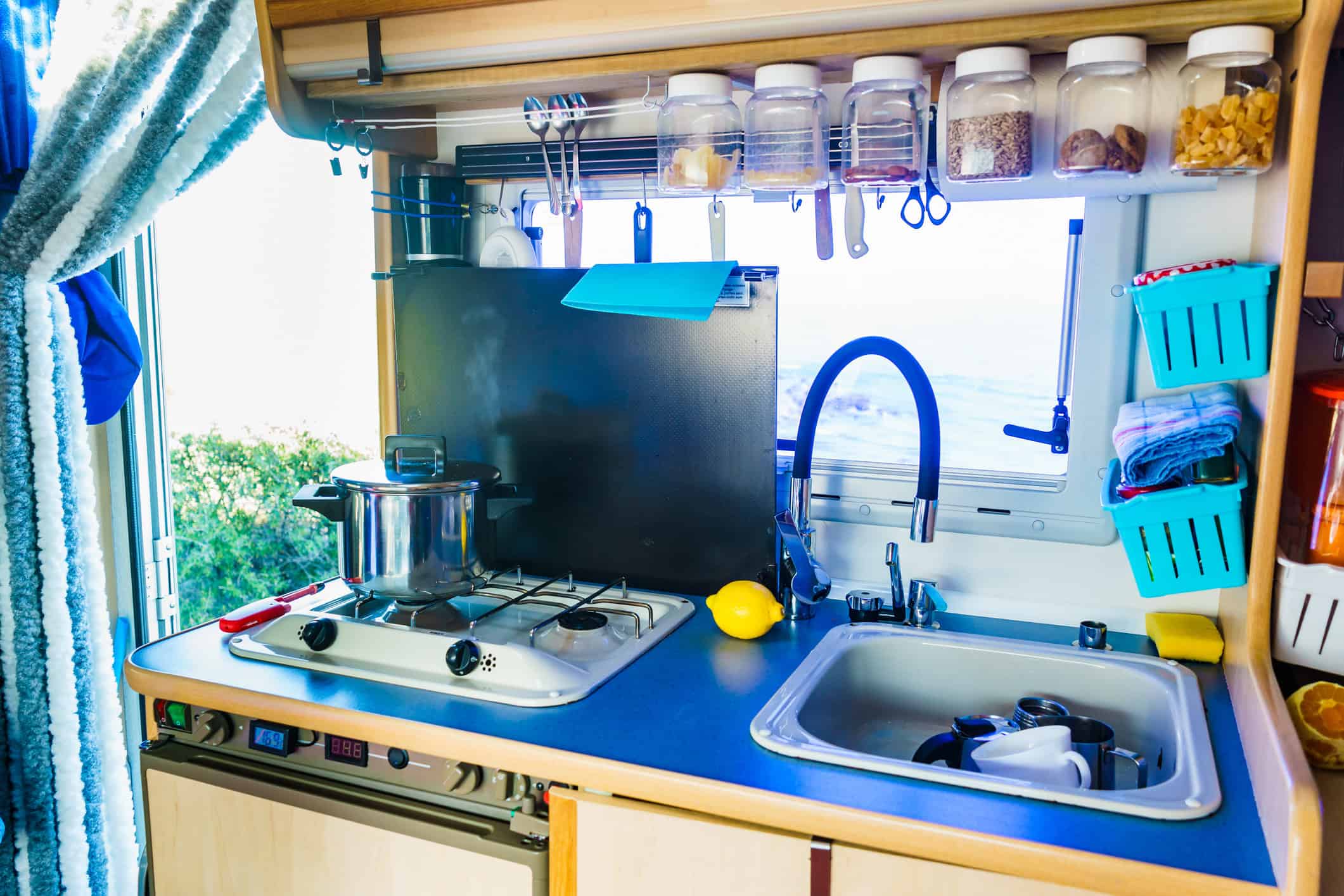
Galley Kitchen (Straight-Line)
What it is: Appliances and bench arranged along one wall in a straight line. Stovetop, sink, and bench in a row with the fridge at one end.
The advantage: Simple, space-efficient, and leaves the opposite wall free for lounge seating or dinette. Works well in narrower and shorter vans. Easy traffic flow past the kitchen.
The downside: Limited bench space. Preparing a meal with multiple components means shuffling everything along a single strip. No ability to “turn” between tasks; everything is lateral movement.
Best for: Compact and mid-size vans. Couples who cook simple meals. Layouts where the opposite wall serves another critical function.
L-Shaped Kitchen
What it is: Kitchen wraps around a corner, typically along one wall and across the rear or front of the van. Creates two arms of bench space meeting at a corner.
The advantage: More bench space than a galley layout. The corner creates a natural “workstation” feel where you can turn between stovetop and sink easily. Often includes more storage (corner cabinets). The most popular kitchen layout in mid-size to full-size Australian caravans.
The downside: The corner can create a “dead zone” that’s hard to access and wastes space unless fitted with a lazy Susan or similar solution. Takes up more floor area than a galley.
Best for: Mid-size to full-size vans. People who cook regularly and need prep space. Families preparing larger meals.
U-Shaped Kitchen
What it is: Kitchen wraps around three sides, creating an enclosed cooking area. Rare in caravans due to space requirements but found in some larger vans and motorhomes.
The advantage: Maximum bench and storage space. Everything is within arm’s reach. Feels like a home kitchen scaled down.
The downside: Consumes significant floor space. Only practical in vans over 22 feet. Can feel enclosed and block traffic flow through the van.
Best for: Serious cooks in large caravans who prioritise kitchen functionality above all else.
Rear Kitchen
What it is: Kitchen positioned at the rear of the van, often opening toward the door or an external awning area.
The advantage: Connects indoor and outdoor cooking. Can serve as an extension of the outdoor living area. Keeps cooking smells and heat at the far end of the van from the bedroom.
The downside: Reduces rear storage options (tunnel boot space). The rear of the van gets the most movement during towing, so cupboard contents are more likely to shift and rattle.
Best for: People who cook outdoors frequently and want a seamless indoor-outdoor kitchen experience.
Slide-Out Outdoor Kitchens
What it is: A kitchen module that slides out from the van’s exterior wall, typically including a stovetop, prep space, and sometimes a sink. Can supplement or replace the internal kitchen.
The advantage: Frees up interior space that would otherwise be consumed by a full kitchen. Perfect for Big Lappers who prefer outdoor cooking. Keeps cooking heat, steam, and smells outside the van. Easy access to the outdoor fridge/freezer.
The downside: Useless in bad weather unless you have a substantial awning. Limited by what fits in the slide-out module. More expensive to install than modifying an internal kitchen. Potential for water ingress if not properly sealed.
Best for: Compact vans where interior space is premium. People who cook outdoors in all seasons. Those wanting to maximise interior living space.

Modifying Your Kitchen Layout
Many Big Lappers modify their kitchen setup to gain space or improve functionality. The most common changes involve replacing bulky appliances with compact, multi-purpose alternatives.
Replace the oven. Traditional caravan ovens consume significant bench and cupboard space. A combination microwave-convection oven (like the Sharp R-8420) gives you microwave, grill, and convection cooking in half the space. Mount it above the bench to free up cupboard storage below.
Switch to induction cooking. Removing the built-in gas cooktop and fitting a portable induction cooktop creates more bench space when not cooking. Store the induction unit in a cupboard and use the reclaimed bench space for prep. Works best with adequate 240V power (solar or generator).
Add bench space. Install a flip-up bench extension or pull-out cutting board. Popular in galley kitchens where permanent bench space is limited but you occasionally need room for larger prep tasks.
Before removing an oven, consider how often you actually bake on the road. Many Big Lappers find they use the oven space for storage more than cooking.
What Actually Matters In A Caravan Kitchen
Bench space. The single most important kitchen feature. You need enough flat surface to chop, prep, and plate. A kitchen that looks spacious with nothing on the bench feels very different when the cutting board, a pot, and ingredients are all competing for room. Test it mentally with a real meal scenario.
Proximity to the door. Carrying heavy grocery bags from the car to the kitchen is a daily occurrence. A kitchen near the entrance door reduces the carry distance and prevents tracking dirt through the living area.
Ventilation. A window or rangehood above the stovetop prevents the van filling with cooking smells and steam. Essential for any layout. If the van doesn’t have it, budget for installing a 12V rangehood.
Storage. Overhead cupboards above the bench, drawers below, a pantry cupboard, and spice storage. Check the drawers have catches (so they don’t fly open while towing) and the cupboards are deep enough for actual kitchen items.
- L-shaped kitchens offer the best balance of bench space and efficiency for most Big Lappers.
- Galley kitchens work in compact vans but limit prep space for larger meals.
- Slide-out outdoor kitchens free up interior space but depend on good weather.
- Replacing the oven with a combination microwave and using portable induction can reclaim significant space.
- Bench space is the single most important kitchen feature. Test it with a real meal scenario.
Comment (0)